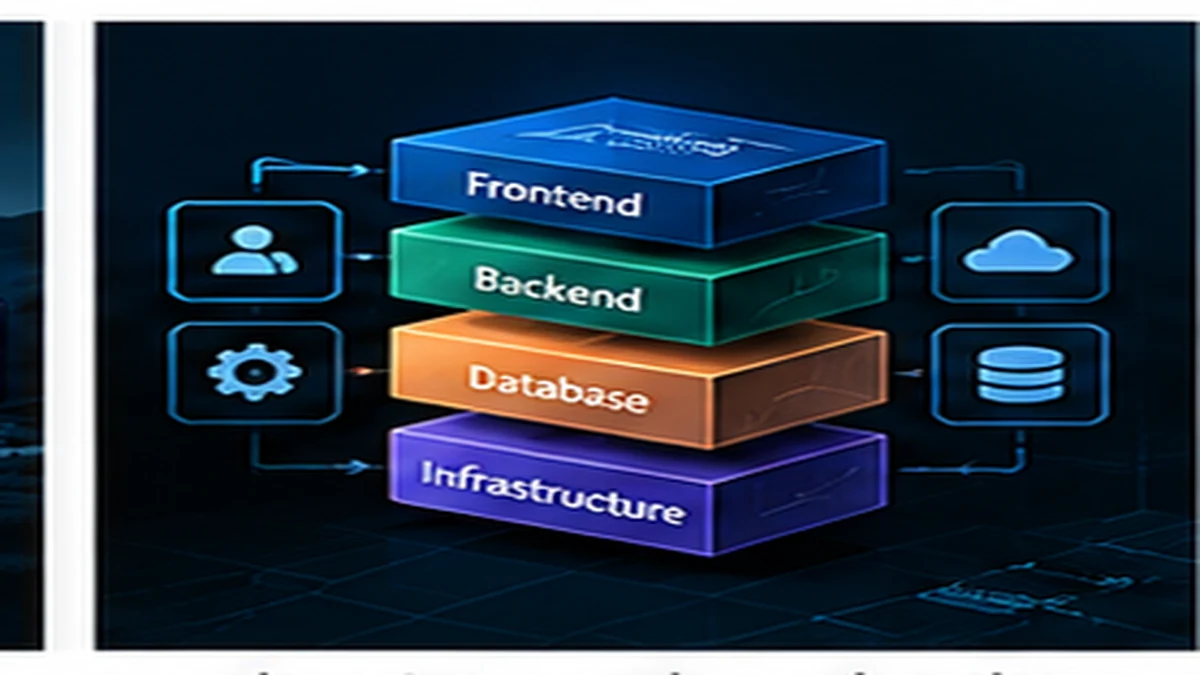
Technology selection often begins with enthusiasm for a specific language, framework, or cloud platform. The useful question is not "What is the best stack?" but "Which technology choices fit the requirements, team, timeline, and operational constraints of this specific application?"
A tech stack is a consequence of decisions about what the software needs to do, who will build and maintain it, how quickly it must ship, and what operational complexity the business can support.
Start with requirements, not technology
Before comparing frameworks or databases, define what the application actually needs to accomplish:
- Who will use it? Internal staff, customers, partners, or API consumers have different performance and usability expectations.
- What scale? Ten users, ten thousand users, or ten million users create different architectural constraints.
- What must it integrate with? Existing systems, third-party APIs, legacy databases, or internal tools constrain technology choices.
- What are the data requirements? Transactional consistency, complex queries, real-time analytics, or document storage inform database selection.
- What are the regulatory or security requirements? Compliance standards, data residency, audit trails, or access controls may narrow options.
- What is the delivery timeline? A working prototype in two weeks requires different choices than a scalable platform in six months.
Starting with requirements helps avoid choosing tools that solve problems the application does not have.
The team is part of the tech stack
The most technically elegant technology choice can fail if the team cannot effectively build or maintain it.
Existing expertise matters
A team proficient in a mature, well-supported stack can often deliver faster and with fewer risks than a team learning a newer technology under deadline pressure. Familiarity with debugging, deployment, performance tuning, and common pitfalls creates velocity.
Hiring and maintainability
Consider whether the business can hire developers with the required expertise. A niche language or framework may offer technical advantages but create long-term staffing challenges. Conversely, widely adopted technologies have larger talent pools, more documentation, and more third-party tools.
Learning curve and productivity
New tools introduce ramp-up time. A complex framework with significant abstraction may slow initial progress. Simpler tools with explicit behaviour can sometimes deliver faster even if they require more code.
Choosing a stack the team can confidently operate in production is more important than choosing the stack with the most GitHub stars.
Consider the application's operational needs
Technology choices create ongoing operational work. Some stacks require more infrastructure management, monitoring, tuning, or security patching than others.
Deployment and hosting
Does the stack deploy easily to the available infrastructure? Managed platform services reduce operational burden but may increase cost or reduce flexibility. Self-hosted infrastructure offers control but requires expertise in networking, scaling, backups, and monitoring.
Observability and debugging
Can the team effectively monitor, log, profile, and troubleshoot production issues? Mature ecosystems typically have better tooling for observability. Newer technologies may require custom instrumentation.
Security and maintenance
How often do dependencies require security patches? How stable is the technology? Frequent breaking changes in libraries or runtime versions create maintenance burden. Long-term support and backwards compatibility reduce operational friction.
Database and data requirements
Database selection depends on data structure, access patterns, consistency requirements, and scale.
Relational databases
Relational databases (PostgreSQL, MySQL, SQL Server) work well when data has clear relationships, transactions matter, and queries are complex. They offer mature tooling, strong consistency, and well-understood operational characteristics.
Document and NoSQL databases
Document stores (MongoDB, DynamoDB) suit applications with flexible schemas, hierarchical data, or high write throughput. They trade some query flexibility and transactional guarantees for scalability and schema evolution.
Start simple
Many applications begin with a single relational database and add specialized data stores only when specific performance or scale requirements justify the additional complexity. Running multiple database technologies increases operational overhead.
Integrations and ecosystem maturity
The ecosystem around a technology stack includes libraries, tools, hosting options, and third-party integrations.
- Does the stack have mature libraries for required integrations? Payment processors, email services, authentication providers, and other third-party APIs often have official SDKs for popular languages.
- Are there established patterns for common tasks? File uploads, background jobs, caching, API design, and authentication have well-documented solutions in mature ecosystems.
- What is the quality of documentation and community support? Mature technologies have extensive tutorials, Stack Overflow answers, and troubleshooting guides.
- How stable is the ecosystem? Frequent breaking changes in core libraries create maintenance burden.
Delivery speed vs long-term maintainability
Different projects have different tradeoffs between initial delivery speed and long-term operational cost.
Prototypes and MVPs
An early-stage product may prioritize rapid iteration and validation over operational efficiency. Frameworks with conventions, code generation, and batteries-included tooling can accelerate initial development. Technical debt is acceptable when the goal is learning whether the product fits the market.
Production systems
A system expected to operate for years must balance initial delivery speed with maintainability, testability, monitoring, and scalability. Explicit code with clear error handling and logging may take longer to write but is easier to debug and extend.
Incremental evolution
Technology choices do not need to be permanent. Applications can evolve incrementally by replacing components, migrating databases, or refactoring subsystems as requirements change. Starting simple and adding complexity when justified is often safer than overbuilding upfront.
Avoid technology novelty as a strategy
New technologies can offer real advantages, but adopting them introduces risk.
When novelty creates risk
- Unproven at scale: new frameworks may have undiscovered performance or stability issues.
- Incomplete tooling: debugging, profiling, monitoring, and deployment tools may be immature.
- Limited community: fewer developers, fewer tutorials, fewer solved problems.
- Breaking changes: early-stage technologies may not guarantee backwards compatibility.
- Hiring difficulty: finding developers with expertise becomes harder.
When newer technology makes sense
- The technology solves a specific problem better: a new database offers required performance characteristics unavailable in mature options.
- The team has expertise: engineers have production experience with the technology.
- The ecosystem is stabilizing: the technology has reached production maturity with established tooling and community.
- Long-term advantages outweigh migration risk: adopting a better-supported, more maintainable platform justifies the upfront cost.
When complexity is actually justified
Some applications genuinely need sophisticated architectures, but many do not.
Microservices
A monolithic application can often handle significant scale before requiring service decomposition. Microservices introduce distributed system complexity: network failures, data consistency, deployment coordination, and monitoring overhead. They become useful when independent deployment, organizational boundaries, or technology diversity justify the operational cost.
Serverless and managed platforms
Serverless platforms (AWS Lambda, Google Cloud Functions) eliminate infrastructure management but introduce constraints on execution time, statelessness, and cold start latency. They work well for event-driven workflows, infrequent batch jobs, and applications with spiky traffic. They may not suit long-running processes or latency-sensitive APIs.
Caching and message queues
Adding Redis, Kafka, RabbitMQ, or other infrastructure components solves specific performance or reliability problems but increases operational complexity. Introduce them when profiling or monitoring identifies a bottleneck, not preemptively.
A practical tech-stack decision process
- Define requirements clearly. List functional, performance, security, integration, and regulatory requirements.
- Assess team capability. Identify existing expertise and evaluate learning curves for new technologies.
- Map operational constraints. Determine hosting options, deployment processes, monitoring tools, and maintenance capacity.
- Identify integration needs. List third-party services, internal systems, and APIs the application must interact with.
- Evaluate database requirements. Choose based on data structure, transactions, query patterns, and consistency needs.
- Prioritize simplicity. Start with the simplest stack that meets requirements. Add complexity only when justified by specific constraints.
- Validate with a spike. Build a small proof-of-concept to verify that the stack handles core requirements.
- Plan for evolution. Choose technologies that allow incremental replacement of components as needs change.
The goal is a working, maintainable application
The best tech stack is the one that ships a working application the team can confidently operate and evolve. Choosing boring, well-understood technology often delivers better long-term outcomes than chasing trends. Start with the problem, consider the team, plan for operations, and choose the simplest architecture that works.
Published by the DSSS Engineering Team. For corrections or topic requests, use the contact page.