
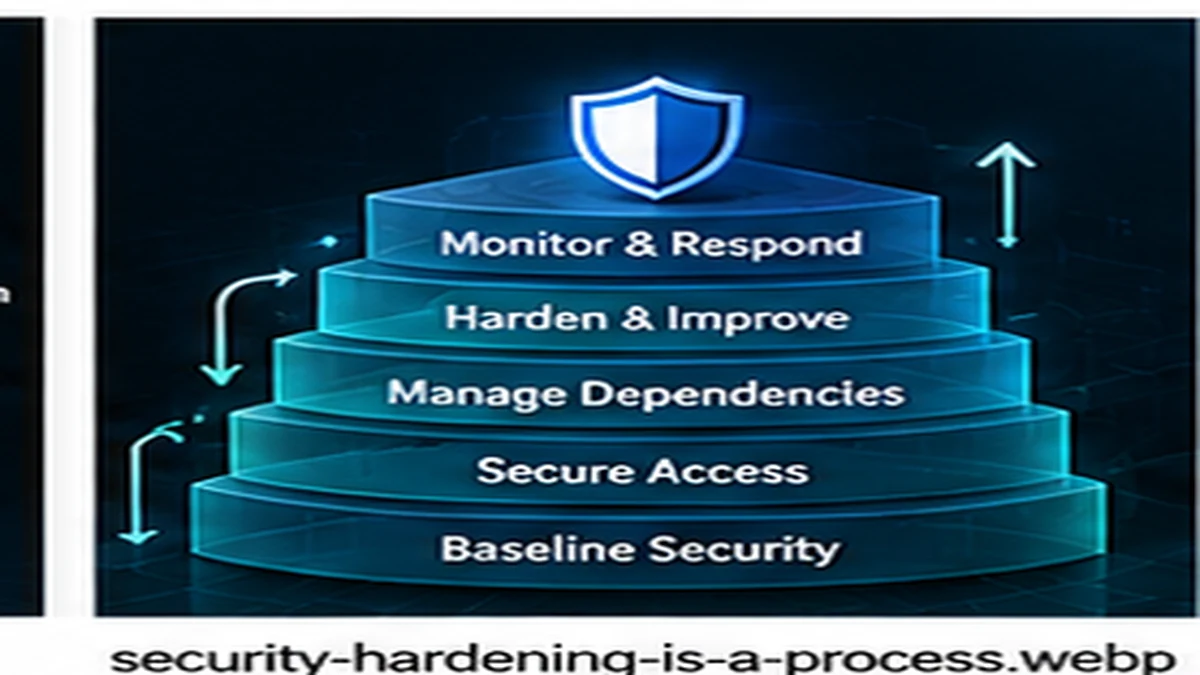
Security hardening is not a checklist completed before launch. It is a continuous process of reducing attack surface, strengthening controls, monitoring threats, and responding to new vulnerabilities. Applications become more secure over time through deliberate incremental improvement, not one-time projects.
Start with baseline controls
Baseline security establishes a minimum acceptable level of protection. These controls prevent the most common attacks and create a foundation for further hardening.
Baseline security checklist
- Authentication: require strong passwords, enforce MFA for sensitive access
- Authorization: enforce least privilege, verify permissions at every boundary
- Encryption: use HTTPS, encrypt sensitive data at rest
- Input validation: sanitize and validate all user inputs
- Secrets management: no credentials in code or version control
- Dependency updates: patch known vulnerabilities
- Logging: record security events for detection and investigation
Baseline controls address the most common security mistakes. Once established, teams can focus on deeper hardening.
Reduce attack surface
Attack surface is the sum of all entry points an attacker can target. Reducing it limits exposure.
Minimize exposed endpoints
- Remove unused APIs, routes, and features
- Disable unnecessary services and ports
- Restrict admin interfaces to internal networks
- Require authentication for all non-public endpoints
Limit data exposure
- Return only necessary data in API responses
- Redact sensitive information in logs and error messages
- Implement field-level access controls
- Expire or delete unnecessary data
Strengthen identity and access management
Weak authentication and authorization are common attack vectors. Strengthening identity controls protects against unauthorized access.
Authentication hardening
- Enforce multi-factor authentication for all users
- Implement account lockout after failed login attempts
- Use secure session management (expiration, rotation, secure cookies)
- Monitor for credential stuffing and brute force attacks
- Require password complexity and prevent common passwords
Authorization hardening
- Implement role-based or attribute-based access control
- Review and audit permissions regularly
- Enforce object-level authorization (users can only access their own data)
- Log authorization failures for investigation
Maintain dependency hygiene
Third-party libraries introduce vulnerabilities. Dependency hygiene means keeping them updated, removing unused packages, and monitoring for known exploits.
Dependency management practices
- Scan dependencies for vulnerabilities regularly
- Automate security updates for minor and patch versions
- Review changelogs before major version updates
- Remove unused or abandoned libraries
- Monitor security advisories for critical dependencies
Logging and monitoring for detection
Security hardening includes the ability to detect and respond to attacks. Logging security events and monitoring for suspicious patterns enables faster incident response.
What to log for security
- Authentication events (login, logout, failed attempts)
- Authorization failures
- Privilege escalation attempts
- Sensitive data access
- Configuration changes
- Unusual API usage patterns
Security monitoring patterns
- Alert on repeated failed login attempts from the same IP
- Detect unusual access patterns (e.g., access from unexpected locations)
- Monitor for privilege escalation attempts
- Track failed authorization checks
- Identify anomalies in API usage
Patching and updates
Unpatched systems remain vulnerable to known exploits. Establishing a patch management process reduces risk.
Patch priorities
- Critical vulnerabilities: patch within days (actively exploited or high impact)
- High severity: patch within 1-2 weeks
- Medium severity: patch during regular maintenance windows
- Low severity: batch with other updates
Patch process
- Test patches in staging before production deployment
- Have rollback procedures ready
- Communicate planned maintenance windows
- Document what was patched and when
Incident readiness
Security incidents will occur. Readiness means having processes to detect, contain, and recover from breaches.
Incident response basics
- Define who responds to security incidents
- Establish communication channels for escalation
- Document common incident types and response procedures
- Practice incident response through tabletop exercises
- Maintain backups for recovery
- Have legal and compliance contacts ready
Continuous security improvement
Security hardening never ends. New vulnerabilities emerge, attack techniques evolve, and systems change. Continuous improvement keeps security relevant.
Security improvement practices
- Review security posture quarterly
- Conduct periodic security assessments or audits
- Learn from security incidents (post-mortems)
- Stay informed about emerging threats
- Update security controls as the application evolves
- Train team members on secure coding practices
Security maturity levels
Security matures in stages. Teams do not need to implement everything at once.
Level 1: Baseline
Authentication, authorization, encryption, input validation, secrets management, dependency updates, logging.
Level 2: Hardened
MFA, least privilege, attack surface reduction, security monitoring, patch management.
Level 3: Mature
Incident response, security training, regular assessments, threat modeling, automated security testing.
Security is a journey, not a destination
Applications become more secure through deliberate, incremental hardening. Start with baseline controls, reduce attack surface, strengthen identity management, maintain dependency hygiene, log security events, patch vulnerabilities, and prepare for incidents. Security maturity develops over time as teams learn, respond to threats, and continuously improve. For foundational security practices, see Security for Growing Products.
Published by the DSSS Engineering Team. For corrections or topic requests, use the contact page.