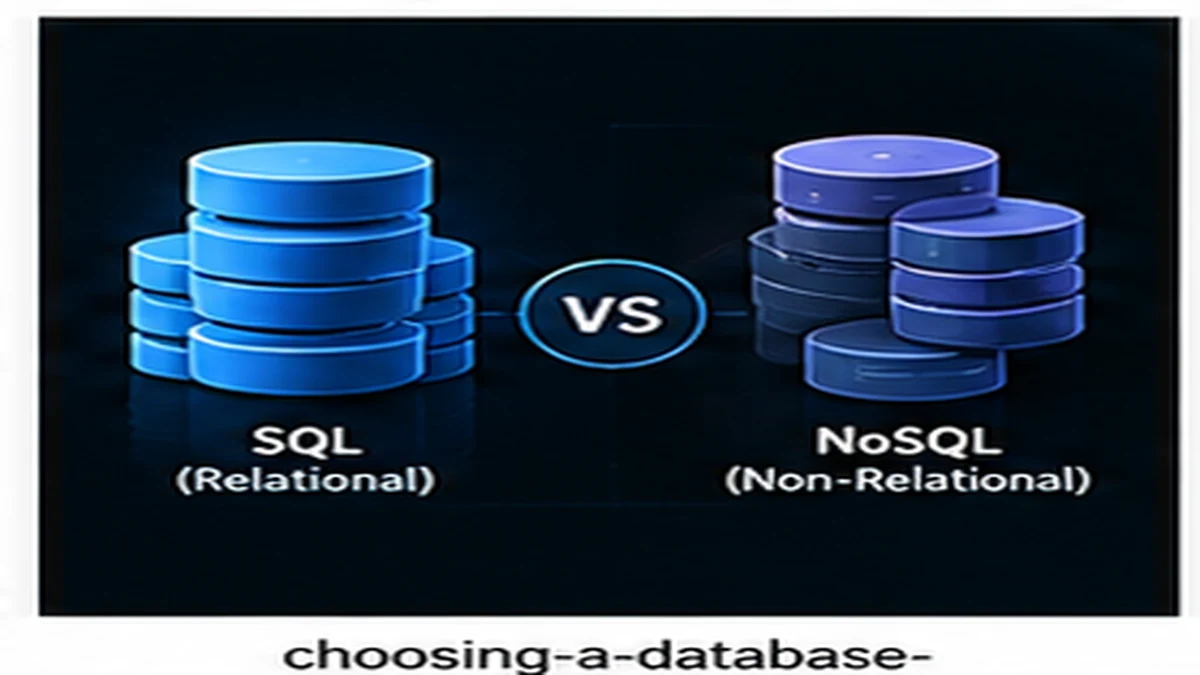
Database selection affects application performance, scalability, maintainability, and operational complexity for years. The right choice depends on data structure, relationships, transaction requirements, query patterns, scale expectations, consistency needs, and team familiarity. No database is universally superior—each trades off different concerns.
Start with the data model
The shape and structure of your data inform which database type fits best.
Structured data with relationships
If data has clear schemas, foreign key relationships, and requires joining across tables, relational databases (PostgreSQL, MySQL, SQL Server) are well-suited. Examples: orders with line items, users with roles, invoices with payments.
Document-oriented data
If data is hierarchical, nested, or varies in structure between records, document databases (MongoDB, DynamoDB, Firestore) may fit better. Examples: product catalogs with varying attributes, user profiles with custom fields, event logs with flexible schemas.
Simple key-value data
If access patterns are primarily "get value by key," key-value stores (Redis, DynamoDB) optimize for this. Examples: session storage, caching, configuration data.
Transactions and consistency
Transaction requirements determine how strongly consistent the database must be.
When ACID transactions matter
Financial applications, inventory systems, and workflows requiring multi-step operations need ACID guarantees (Atomicity, Consistency, Isolation, Durability). Relational databases provide strong transactional support. Examples: transferring money between accounts, processing orders with inventory updates.
When eventual consistency is acceptable
Some applications can tolerate temporary inconsistency for higher availability and scalability. Examples: social media feeds, analytics dashboards, content delivery. Many NoSQL databases trade immediate consistency for partition tolerance and availability.
Query patterns
How the application accesses data shapes database selection.
Complex queries and joins
Applications requiring ad-hoc queries, aggregations, and multi-table joins benefit from SQL databases. SQL provides a powerful, standardized query language for complex data retrieval.
Simple, predictable queries
If queries are primarily "fetch record by ID" or "fetch all records matching a field," NoSQL databases optimize for these patterns. Designing for known access patterns allows efficient data modeling.
Full-text search
Applications requiring text search, ranking, and relevance scoring may benefit from specialized search engines (Elasticsearch, Algolia) alongside a primary database.
Scale expectations
Anticipated data volume and traffic influence database choice.
Vertical scaling (relational)
Relational databases scale vertically (larger servers) well but have limits. Many business applications fit comfortably within single-server relational databases for years.
Horizontal scaling (NoSQL)
NoSQL databases often scale horizontally (more servers) more easily. This matters at large scale but introduces complexity that small applications do not need.
Avoid premature scaling decisions
Start with a database that fits current needs. Many applications never reach the scale where NoSQL's horizontal scaling advantages justify its operational complexity.
Operational complexity and team familiarity
Consider who will operate and maintain the database.
Team expertise
Teams familiar with SQL can deliver faster with relational databases. Learning a new database type under deadline pressure creates risk.
Managed vs self-hosted
Managed database services (AWS RDS, Azure SQL, MongoDB Atlas) reduce operational burden but increase cost and may limit flexibility. Self-hosted databases offer control but require expertise in backups, replication, monitoring, and scaling.
Tooling and ecosystem
Mature databases have better tooling, more libraries, and more community knowledge. Choosing a newer database may mean building custom tools or working around missing features.
Relational databases: strengths and tradeoffs
Strengths
- Strong ACID guarantees
- Powerful query language (SQL)
- Support for complex joins and aggregations
- Mature tooling and ecosystem
- Well-understood operational characteristics
Tradeoffs
- Schema changes can be complex at scale
- Vertical scaling limits
- Joins across large datasets can be slow
- Fixed schema may not suit highly variable data
Good fit for
Financial applications, ERP systems, inventory management, CRM, order processing, user management, reporting and analytics.
Document databases: strengths and tradeoffs
Strengths
- Flexible schema (documents can vary)
- Natural fit for hierarchical data
- Horizontal scaling
- Fast reads for known access patterns
- No complex joins required
Tradeoffs
- Weaker consistency guarantees (often eventual consistency)
- Limited support for complex queries and joins
- Data duplication to avoid joins
- Requires careful data modeling for access patterns
Good fit for
Content management, product catalogs, user profiles, event logging, real-time data, applications with flexible schemas.
The hybrid approach
Many applications use multiple databases for different purposes.
Polyglot persistence
- Relational database for transactional data
- Redis for caching and sessions
- Elasticsearch for search
- S3 or object storage for files
Hybrid complexity
Multiple databases increase operational burden: more backups, more monitoring, more failure modes, data synchronization challenges. Only introduce additional databases when benefits justify the complexity.
Database selection framework
- Describe the data model: structured relationships, hierarchical documents, or simple key-value?
- Define transaction requirements: strong consistency or eventual consistency acceptable?
- Map query patterns: complex queries and joins, or simple lookups?
- Estimate scale: data volume, read/write throughput, growth rate?
- Assess team capability: what databases does the team know?
- Evaluate operational needs: managed service or self-hosted?
- Consider ecosystem maturity: tooling, libraries, community support?
- Start simple: can a single relational database handle current needs?
Common application patterns
Small internal tools
SQLite or PostgreSQL. Simple, reliable, minimal operational overhead.
SaaS applications
PostgreSQL or MySQL with managed hosting (RDS, Cloud SQL). Strong consistency, mature tooling, predictable scaling.
Content platforms
MongoDB or DynamoDB for content storage, Elasticsearch for search, CDN for static assets.
Analytics platforms
Columnar databases (Redshift, BigQuery) for analytical queries, or time-series databases (TimescaleDB, InfluxDB) for metrics.
Default to relational, diverge deliberately
For most business applications, starting with a relational database (PostgreSQL, MySQL) is the safest choice. They provide strong consistency, powerful queries, mature tooling, and well-understood operations. Introduce NoSQL databases when specific requirements—flexible schemas, massive scale, or particular access patterns—justify the additional complexity. Database decisions are reversible but expensive to change, so choose based on current needs with an eye toward likely evolution.
Published by the DSSS Engineering Team. For corrections or topic requests, use the contact page.